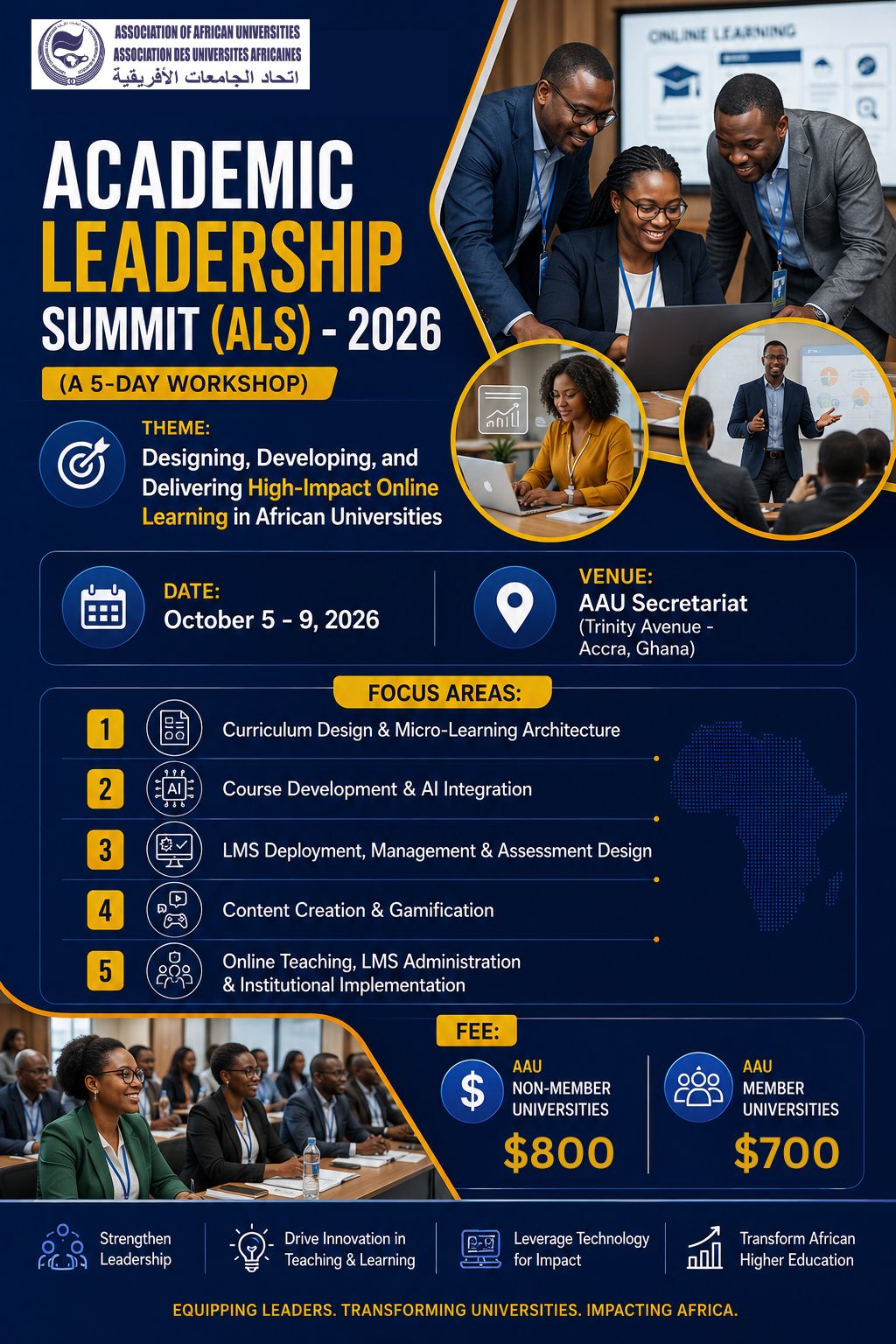
Academic Leadership Summit (ALS) – 2026
Theme: Designing, Developing, and Delivering High-Impact Online Learning in African Universities
The Association of African Universities (AAU) recognizes the critical and accelerating need for African higher education institutions to strengthen their capacity for online education. Although many universities on the continent have established policies and platforms, they continue to encounter distinct challenges, including infrastructure limitations, varying levels of digital proficiency, and resource constraints. Addressing these challenges requires comprehensive, contextually relevant support to ensure the effective design, development, and delivery of high-quality online learning experiences that meet the evolving needs of African students and institutions.
In response, the Academic Leadership Summit (ALS) – 2026 will convene as a five-day, intensive, hands-on workshop from 5–9 October 2026 at the AAU Secretariat in Accra, Ghana. The programme is strategically designed for faculty, instructional designers, IT professionals, and academic leaders from African universities. Through a carefully structured, immersive experience, participants will build a robust online course ecosystem—from curriculum design to implementation and management—tailored to the realities and opportunities within Africa’s higher education landscape.
Register here: https://forms.cloud.microsoft/r/QN0RusjAFN
The workshop adopts a fully integrated, “Build-As-You-Learn” approach in which:
The programme is purposefully structured to be both adaptable and comprehensive, ensuring a holistic and practical approach to building online learning capacity in African universities. All activities will be concentrated within the five-day period, providing an immersive, collaborative learning environment. Participants will explore foundational principles of instructional design and online curriculum development, with a strong emphasis on modular, competency-based micro-learning units tailored to the unique contexts of their institutions. The workshop will guide participants through the process of transforming traditional curricula into detailed lesson plans and engaging digital learning activities. A wide range of digital and interactive tools will be introduced for content creation, assessment design, and personalization, supporting the development of visually engaging and effective online courses. Practical training will be provided in online course setup, management of user roles, and the design of quizzes, assignments, and discussion forums. Additional areas of focus include gamification, assessment strategies, and best practices in online teaching and learner support. To enrich the workshop experience and contextualize learning, a site visit to a member university aligned with the workshop theme will be organized, offering valuable insights into real-world implementation. Participants will have the opportunity to develop institutional implementation plans and present their completed projects, ensuring that acquired skills and outputs can be scaled and sustained within their home institutions. This flexible design allows the programme to adapt to the diverse and evolving needs of African universities, fostering a culture of innovation, collaboration, and enduring impact.
Register here: https://forms.cloud.microsoft/r/QN0RusjAFN
Registration covers the full workshop package, including all training materials, certificates, refreshments, and lunches for the duration of the five-day programme. Participants are responsible for their own dinners and accommodation arrangements.
Participation will be confirmed upon completion of registration and payment by September 02, 2026
BANK DETAILS
INTERNATIONAL BANK TRANSFER (ALL OTHER COUNTRIES)
ONLINE PAYMENT DETAILS – https://pay.aau.org/als-accra-2026
GHANA CEDI ACCOUNT (GHANA ONLY)
GHANA DOLLAR ACCOUNT (GHANA ONLY)
To ensure effective participation and successful completion of the workshop, all participants are required to come prepared with the following:
The Academic Leadership Summit 2026 is structured as a transformative programme, ensuring that participants from African universities depart not only with enhanced knowledge but also with fully developed, deployable, and scalable digital learning solutions tailored to the African context. This summit stands as a catalyst for accelerating digital transformation and fostering lasting educational innovation across Africa’s higher education landscape.
WORKING LANGUAGE
The workshop will be conducted in English only.
VISA PROCESSING
The Association of African Universities will present delegates with invitation letters, after registration, to facilitate their application of visas at any Ghana Embassy or Consulate in their home countries. Delegates from the ECOWAS region countries do not need a visa to enter Ghana.
RECOMMENDED HOTEL(S)/GUEST HOUSES:
Generally, participants are advised to lodge at hotels in Accra, specifically in East-Legon and its close environs. The AAU logistics team for the workshop remain available to support with hotel bookings. Below are some hotels for consideration:
The Association of African Universities (AAU) founded in 1967 with an initial membership of 34 universities, currently has more than 400 member institutions spread across 46 African countries. The Association represents the voice of higher education in Africa and draws its membership from all five sub-regions of Africa and operates in four official languages, namely English, French, Portuguese and Arabic. The Association’s mandate as an apex organization for higher education in Africa is to promote cooperation, academic linkages and exchange of information on higher education issues across the continent. The mandate further extends to support members in their core functions of teaching, learning, knowledge generation and its dissemination through fundamental and applied research and community engagement. The AAU also plays a key role in setting up dialogue platforms, advocacy and raising awareness for and about the major needs of African higher education institutions and coordinates the means by which these needs are met. The Association also acts as a catalyst for increased networking between and among its members and the wider African and international higher education academic community.