
Vacancy for a Head of Information Technology (IT)
February 25, 2026
Member University in Focus: University of Ilorin, Nigeria, West Africa
March 17, 2026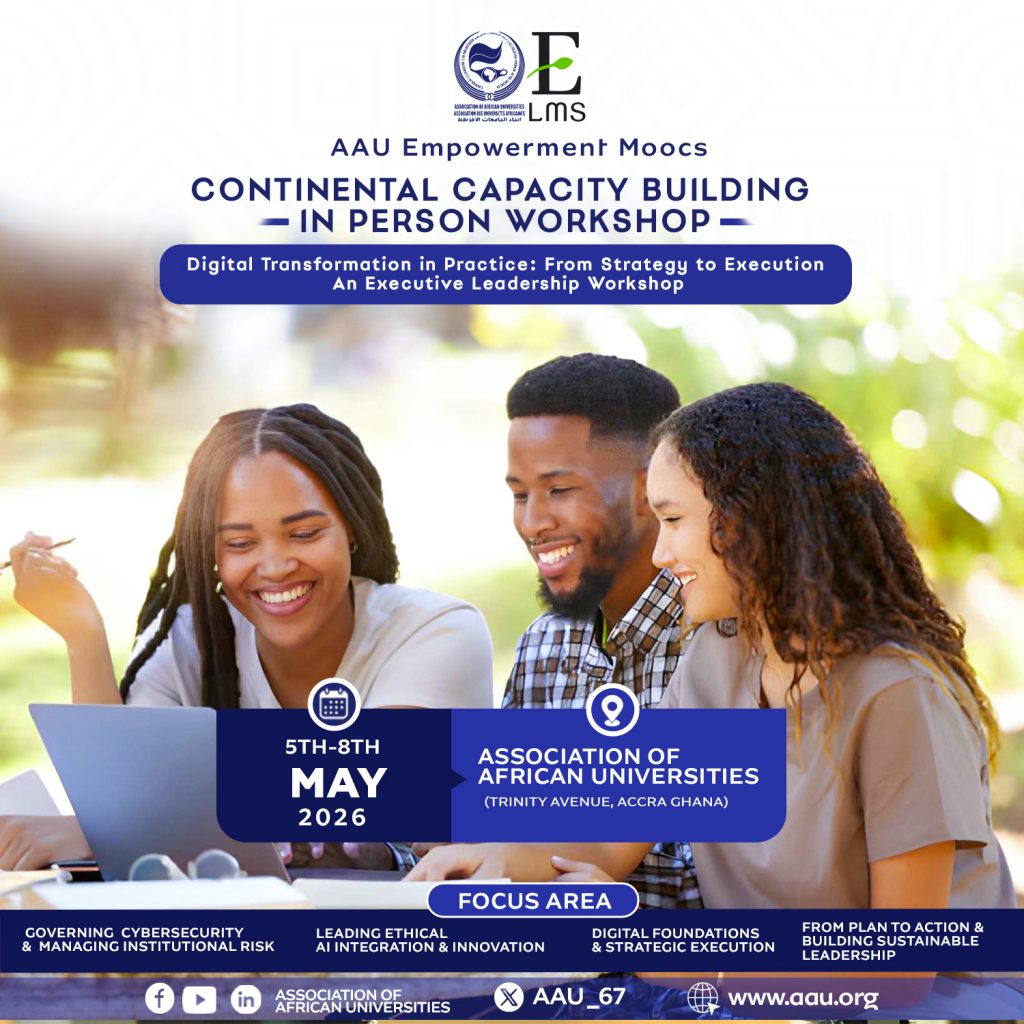
Dates: May 5-8, 2026
Venue – Association of African Universities (AAU) Secretariat, Accra Ghana
1.0 Executive Summary
The Association of African Universities (AAU), in partnership with eLearnAfrica, is convening a flagship Executive Leadership Workshop to empower the key agents of change within the African higher education ecosystem. This workshop is designed for senior leaders who drive digital transformation strategy-such as Deputy Vice-Chancellors, Registrars, and Directors – as well as the faculty and administrators who leverage technology daily in teaching, research, and operations.
This immersive 4-day workshop provides a critical forum for leaders to move from awareness to action. Focusing on key pillars of modern institutional readiness – Cybersecurity, Artificial Intelligence (AI), and Essential Digital Skills – participants will develop the knowledge and practical frameworks needed to make informed decisions, manage risks, and implement effective strategies. The outcome is a tailored Institutional Action Plan and membership in a vital pan-African network, directly supporting strategic leadership in digital transformation across the continent, aligned with the AAU Strategic Plan 2024 – 2030.
[Note: This workshop additionally serves as the capstone experience for university teams from the AAU-eLearnAfrica MOOC series on these same topics, allowing for the practical application of that foundational knowledge.]
2.0 BACKGROUND AND RATIONALE
Digital transformation in higher education is no longer confined to the IT department; it is a core strategic imperative that impacts teaching, research, administration, and institutional reputation. Senior leaders, faculty, and administrators are critical to its success but often lack the specific knowledge to guide strategy and implementation effectively. Key challenges include:
· Governance & Risk: A need to understand cybersecurity threats and governance to protect institutional data and comply with regulations.
· Strategic Adoption: Uncertainty about how to ethically and effectively integrate AI tools into academic and administrative workflows.
· Operational Efficiency: Gaps in leveraging digital productivity tools to streamline processes and enhance collaboration.
This workshop addresses these gaps by translating complex digital concepts into strategic leadership frameworks. It empowers participants to champion secure innovation, lead their units through a responsible digital transition, and collaborate more effectively across technical and academic domains.
3.0 WORKSHOP OBJECTIVES
Upon completion, participants will be able to:
· Articulate the core principles of institutional cybersecurity, ethical AI adoption, and digital productivity to make informed strategic decisions.
· Develop a practical Digital Leadership Action Plan to address a key challenge within their own school, department, or administrative unit.
· Evaluate technology proposals and policies through the lenses of risk management, ethical impact, and operational sustainability.
· Connect with a continental peer network of senior leaders to facilitate ongoing collaboration and shared problem-solving.
4.0 Target Participants
This workshop is designed to convene 40–60 senior academic and administrative leaders from across the continent who are directly responsible for implementing and championing digital initiatives. The primary audience includes:
- University Executives & Senior Administrators: Including Deputy Vice-Chancellors (Academic & Administration), Registrars, Deans, Directors of Academic Planning, and Heads of Administration who set strategic priorities.
- Senior Faculty & Academic Leaders: Such as Heads of Department, Professors, and Directors of Research or Digital Learning who integrate technology into pedagogy and research.
- Digital Strategy Champions: Administrative and academic staff in roles such as Quality Assurance Officers, Librarians, and Heads of Units who are tasked with leading specific digital transformation projects.
- Participants of the AAU-eLearnAfrica MOOCs: Participants who have completed the foundational online courses and are ready to apply that knowledge at a strategic, institutional level.
- Other key institutional representatives keen to learn more and engage in the process of digital transformation
This composition ensures a dynamic mix of strategic vision and operational expertise, fostering rich dialogue and the development of practical, actionable plans.
5.0 Program Structure and Methodology
The workshop employs an executive-level, experiential methodology that moves beyond theory to focus on applied strategy and collaborative problem-solving. The format is designed to foster leadership development, peer learning, and the creation of immediately actionable outputs through a blend of:
- Strategic Keynotes & Leadership Dialogues
- Interactive, Scenario-Based Workshops
- Hands-On Application Labs
- Collaborative Capstone Project Development
- Structured Peer Networking & Review
DAY 1: GOVERNING CYBERSECURITY & MANAGING INSTITUTIONAL RISK
Morning Session: Strategic Risk Assessment
Executive Workshop: Conduct a threat landscape analysis using real-world African university case studies. Participant groups will perform a security risk assessment as the foundation for their Capstone Project.
Afternoon Session: Operational Resilience
Leadership Lab: Interactive sessions on defensive tools and protocols, including phishing simulation and multi-factor authentication (MFA). Focus on integrating data protection principles and incident response frameworks into project planning.
DAY 2: LEADING ETHICAL AI INTEGRATION & INNOVATION
Morning Session: AI Tools for Academic & Administrative Excellence
Applied Learning Rotation: Participants engage with curated AI tools designed for Research Enhancement, Academic Content Creation, and Institutional Data Analysis.
Afternoon Session: Frameworks for Responsible Adoption
Strategy Workshop: Develop and apply an ethical AI governance framework, evaluating tools through principles of fairness, transparency, and accountability. Synthesize AI solutions into the Capstone Project to ensure they are innovative, practical, and ethically sound.
DAY 3: DIGITAL FOUNDATIONS & STRATEGIC EXECUTION
Morning Session: Vision & Launch
Official Opening and Keynote Address on “Digital Leadership for African Higher Education.”
Launch of the Capstone Project: A collaborative, group-based initiative tackling a pressing institutional challenge (e.g., enhancing student digital services, optimizing administrative workflows).
Afternoon Session: Advanced Digital Fluency
DAY 4: FROM PLAN TO ACTION & BUILDING SUSTAINABLE LEADERSHIP
Morning Session: Capstone Project Presentations & Strategic Peer Review
Groups present their integrated solutions to a panel and peers, fostering a collaborative review and refinement process.
Afternoon Session: Institutional Roadmapping & Network Launch
Action Planning Workshop: Translate Capstone Project insights into a personalized 12-Month Digital Transformation Action Plan for each participant’s institution.
Formal launch of the AAU Digital Leaders Network.
Certificate Award Ceremony
6.0 Key Outputs and Outcomes
| Outputs | Outcomes |
| Capstone Project Portfolio: 15-20 group case studies solving real institutional challenges. | Enhanced Institutional Capacity: Staff return with actionable plans and proven prototypes. |
| Draft Digital Transformation Action Plans: Personalized 12-month roadmaps for each participant’s institution. | Improved Cybersecurity Posture: Practical skills and policies to mitigate institutional risk. |
| AAU Digital Leaders Network: A launched, active community of practice. | Accelerated, Ethical AI Adoption: Readiness to implement AI tools with appropriate safeguards. |
| Joint AAU-eLearnAfrica Certificates of completion. | Strengthened Continental Collaboration: A sustainable network for peer learning and South-South cooperation. |
7.0 Monitoring, Evaluation, and Sustainability
- Pre-/Post-Workshop Surveys: Measuring growth in knowledge, confidence, and strategic clarity.
- Action Plan Tracking: Follow-up at 3, 6, and 12 months via the Digital Leaders Network to monitor implementation progress.
- Success Metrics: Number of action plans initiated, tools adopted, policies influenced, and ongoing engagement in the network.
- Sustainability: The workshop model and network are designed to be replicated annually, with future cycles focusing on new thematic areas (e.g., data management, digital leadership).
8.0 Workshop Fees
- $400 for all participants
Registration covers the conference package including training materials, certificates, tea/coffee, and lunches for the four-day workshop. Participants will be responsible for their own dinners and accommodation.
BANK DETAILS
INTERNATIONAL BANK TRANSFER (ALL OTHER COUNTRIES)
Account Name: Association of African Universities
Bank Name: Standard Chartered Bank, High Street Branch, Accra, Ghana
Acc N#: 8700202448801
Swift Code: SCBLGHAC
ONLINE PAYMENT DETAILS:
GHANA CEDI ACCOUNT (GHANA ONLY)
Account Name: Association of African Universities
Name of Bank: Standard Chartered Bank, High Street Branch, Accra Acc N#: 0100100581500
Swift Code: SCBLGHAC
GHANA DOLLAR ACCOUNT (GHANA ONLY)
Account Name: Association of African Universities
Name of Bank: Standard Chartered Bank, High Street Branch, Accra Acc N#: 870-150-244-8800
Swift Code: SCBLGHAC
9.0 Conclusion
This integrated workshop is the critical lever to transform online learning into on-the-ground impact. It empowers the staff who are the engines of African universities with the skills, tools, peer connections, and strategic plans needed to lead their institutions through a responsible and effective digital transformation.
- Payment link: https://pay.aau.org/digital-empowerment-moocs
- Registration form for the in-person workshop – AAU DIGITAL EMPOWERMENT MOOCs- IN PERSON SESSION
WORKING LANGUAGE
The workshop will be conducted in English only.
VISA PROCESSING
The Association of African Universities will present delegates with invitation letters, after registration, to facilitate their application of visas at any Ghana Embassy or Consulate in their home countries. Delegates from the ECOWAS region countries do not need a visa to enter Ghana.
RECOMMENDED HOTEL(S)/GUEST HOUSES:
Generally, participants are advised to lodge at hotels in Accra, specifically in East-Legon and its close environs. The AAU logistics team for the workshop remain available to support with hotel bookings. Below are some hotels for consideration:
- MJ GRAND HOTEL
- AH HOTEL
- TOMREIK HOTEL
A BRIEF BACKGROUND OF THE AAU
The Association of African Universities (AAU) founded in 1967 with an initial membership of 34 universities, currently has more than 400 member institutions spread across 46 African countries. The Association represents the voice of higher education in Africa and draws its membership from all five sub-regions of Africa and operates in four official languages, namely English, French, Portuguese and Arabic. The Association’s mandate as an apex organization for higher education in Africa is to promote cooperation, academic linkages and exchange of information on higher education issues across the continent. The mandate further extends to support members in their core functions of teaching, learning, knowledge generation and its dissemination through fundamental and applied research and community engagement. The AAU also plays a key role in setting up dialogue platforms, advocacy and raising awareness for and about the major needs of African higher education institutions and coordinates the means by which these needs are met. The Association also acts as a catalyst for increased networking between and among its members and the wider African and international higher education academic community.