Quality Assurance Systems Must Evolve to Prepare Graduates for Future Skills and Emerging Disciplines
July 27, 2026
The Future of Africa Will Be Decided in Its Universities
July 28, 2026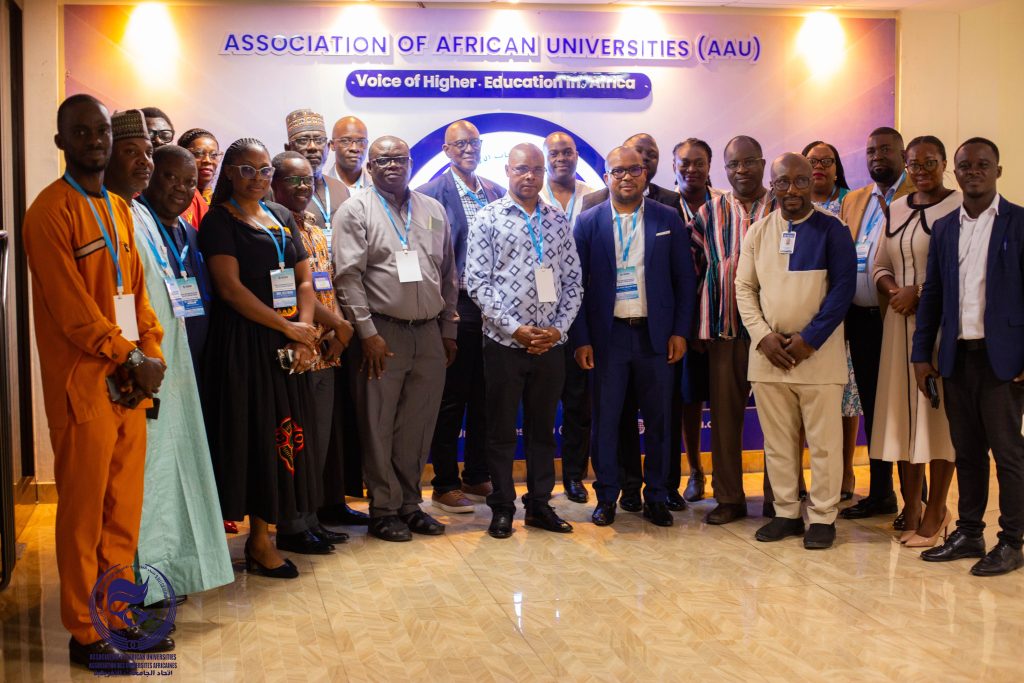
As African universities accelerate their digital transformation journeys, AAU’s Executive Leadership Workshop equipped senior leaders to turn strategy into practical institutional action.
Across the continent, higher education institutions are responding to emerging technologies, changing learner expectations, and growing demands for innovation, resilience, and global competitiveness. In this context, leadership has become central to ensuring that investments in digital transformation strengthen teaching, research, administration, and long-term institutional change.
Responding to this imperative, the Association of African Universities (AAU) convened the Executive Leadership Workshop on Digital Transformation under the theme, “Digital Transformation in Practice: From Strategy to Execution,” from 21 to 24 July 2026 at its Secretariat in Accra, Ghana. The workshop brought together vice-chancellors, senior university administrators, ICT leaders, faculty members, and digital transformation practitioners from across Africa to strengthen leadership capacity in cybersecurity, responsible Artificial Intelligence, digital governance, and institutional action planning.
The workshop reflected AAU’s commitment to supporting African higher education institutions to become resilient, innovative, and future-ready. It also built on the momentum of the AAU-eLearnAfrica Digital Empowerment MOOCs delivered in February 2026, which strengthened foundational knowledge in Artificial Intelligence (AI), Cybersecurity Awareness, and Essential Digital Skills. While the MOOCs focused on digital competencies, the Executive Leadership Workshop shifted the emphasis to institutional leadership and implementation.
Welcoming participants, Prof. Frederick Ato Armah, Director of Research and Programmes, AAU, underscored the need to equip university leaders with strategies for a rapidly changing digital future. He emphasized that “digital transformation is not about digitising university processes; it is about transforming how higher education institutions create, assure, and continuously improve value for students, faculty, industry, and society.” He noted that meaningful transformation requires visionary leadership, institutional commitment, and collaboration.
Introducing the workshop, Dr. Felicia Nkrumah Kuagbedzi, Acting Coordinator, ICT, Communications and Knowledge Management, AAU, outlined its experiential approach, emphasizing implementation, collaboration, and action-oriented outcomes. She noted that the programme was deliberately designed to support participants in “moving from strategy to actionable, institution-specific execution plans, “ensuring that learning translated into measurable institutional change.
The workshop opened with a focus on cybersecurity as a strategic leadership issue in higher education. As universities rely more heavily on digital platforms for teaching, research, administration, and student services, protecting institutional systems and data has become essential to successful digital transformation.
Mr. Eric Akumiah, Africa Regional Liaison for the Forum of Incident Response and Security Teams (FIRST), set the stage with an overview of the evolving cybersecurity landscape affecting African higher education. He highlighted increasingly sophisticated threats, including phishing, ransomware, and data breaches, and urged universities to adopt proactive approaches to digital risk management.
Hands-on demonstrations by representatives from OOSEC, a Ghanaian cybersecurity organisation, introduced strategies for strengthening resilience through phishing awareness, multi-factor authentication, and other preventive measures. Dr. Thomas P. Songu, Head of ICT Services, AAU, complemented these sessions with guidance on incident response planning and managing security breaches in university environments.
Building on the cybersecurity discussions, the workshop turned to Artificial Intelligence, one of the most transformative technologies shaping higher education. In her executive presentation, “The AI Opportunity and Pitfalls in Academia,” Dr. Felicia Engmann, Senior Lecturer, School of Technology, Ghana Institute of Management and Public Administration (GIMPA), explored how generative AI is reshaping research, teaching, administration, and student success, while raising questions around academic integrity, data privacy, transparency, and accountability.
Interactive strategy sessions facilitated by Mr. Chabarwa Ronny Murahwa, ICT Director, Harare Institute of Technology, examined institutional AI governance and responsible adoption. Participants discussed fairness, ethical use, human oversight, and AI applications in admissions, student services, finance, procurement, human resource management, and ICT operations.
The sessions encouraged leaders to view Artificial Intelligence as a strategic enabler of transformation, not simply another digital tool. Discussions reinforced that successful AI integration will depend on leadership, responsible governance, and innovation aligned with the mission of African higher education.
Moving from Policy to Practice
A defining moment was the keynote address by Prof. Olusola O. Bandele, Secretary General of the Association of African Universities, on “Digital Leadership for African Higher Education: Moving from Policy to Practice.” He challenged participants to move beyond digital aspirations and focus on implementation, arguing that “we must move beyond acquiring infrastructure to building sustainable digital ecosystems.” Emphasising the importance of evidence-based leadership, he further noted that “the goal is not simply collecting data; the goal is transforming data into institutional intelligence. “His remarks reinforced the need for leadership, governance, institutional culture, and data-informed decision-making in driving sustainable digital transformation.
The Advanced Digital Fluency session facilitated by Dr. Damien Eke, University of Nottingham, United Kingdom explored cloud collaboration, digital ecosystems, and data governance, highlighting how integrated platforms can improve efficiency, collaboration, and strategic decision-making. The workshop’s implementation focus was reinforced through a study visit to the Artificial Intelligence and Cybersecurity Laboratory at Wisconsin International University College, Ghana, an AAU member institution.
During the visit, participants explored smart infrastructure systems for remote facility management, immersive virtual reality applications in medical education, and advanced cybersecurity and digital forensics facilities supporting research, innovation, and skills development. The demonstrations showcased the growing capacity of African universities to build innovation ecosystems that strengthen teaching, research, skills development, and institutional transformation.
The final phase focused on implementation. In an Institutional Road mapping session, participants assessed their institution’s digital readiness, identified priorities, and developed personalised twelve-month Digital Transformation Action Plans.
To sustain collaboration beyond the workshop, participants launched the AAU Digital Leaders Network, a continental community of practice for peer learning, mentorship, collaboration, and the exchange of best practices. The launch, led by three of AAU’s leadership Prof. Frederick Ato Armah, Dr. Thomas P. Songu, and Dr. Felicia Nkrumah Kuagbedzi, underscored the importance of a sustained leadership community for advancing digital transformation across African higher education.
Participants were also introduced to the African Research Information Database (AfRID), AAU’s continental platform for enhancing research visibility and fostering collaboration among researchers and institutions. Its inclusion reinforced the workshop’s broader message that digital transformation is not limited to infrastructure and administration but also extends to research visibility, knowledge sharing, and continental collaboration.
The Executive Leadership Workshop reaffirmed that the future of African higher education will be shaped not only by technological advancement but also by the quality of leadership guiding institutional change.
Through strategic initiatives such as the Executive Leadership Workshop on Digital Transformation, the African Research Information Database (AfRID), and the AAU Digital Leaders Network, AAU continues to position itself at the forefront of efforts to strengthen institutional resilience, foster innovation, and accelerate digital transformation across the continent’s higher education sector. In doing so, the Association is helping to build a more connected, agile, and future-ready higher education ecosystem for Africa.