Press Release-2025 Africa Universities’ Day to Focus on Reimagining the Future of Learning on the Continent
November 4, 2025
Advancing a Shared Vision: AAU-CAHE Partnership Takes Center Stage at World University Presidents’ Forum
November 10, 2025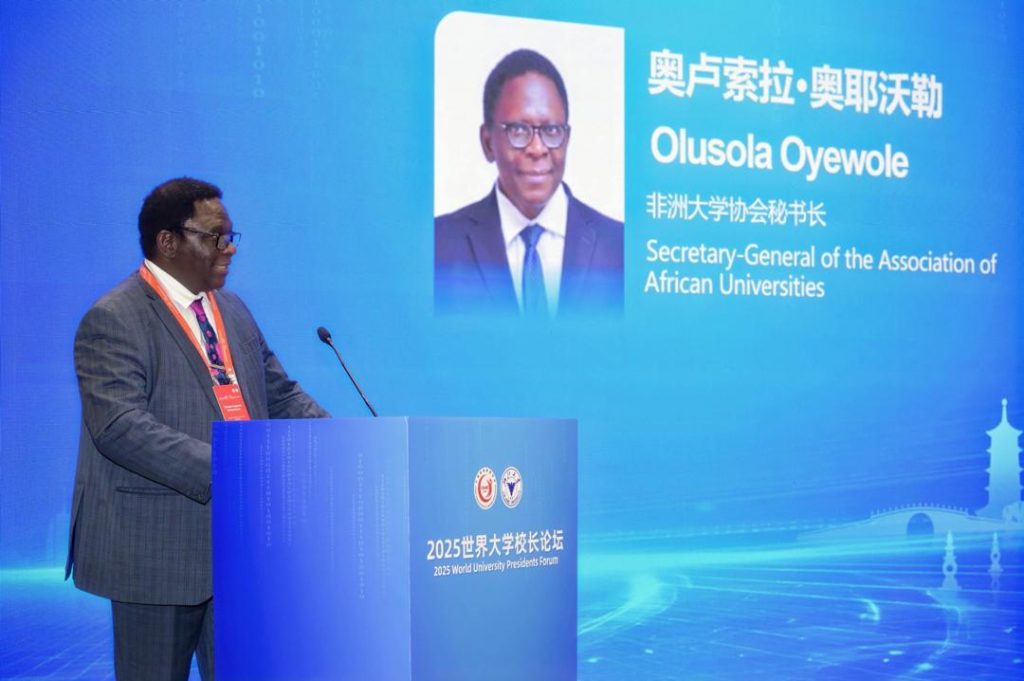
Hangzhou, China – November 8, 2025 – At the forefront of a pivotal global dialogue, the Association of African Universities (AAU) is shaping the conversation on digital transformation and equity at the 2025 World University Presidents Forum and International Forum on Higher Education. In a powerful address to an assembly of global education leaders, AAU Secretary General, Professor Olusola Oyewole, issued a compelling call for “digital justice,” arguing that technology must serve as a bridge to opportunity, not a new frontier for inequality.
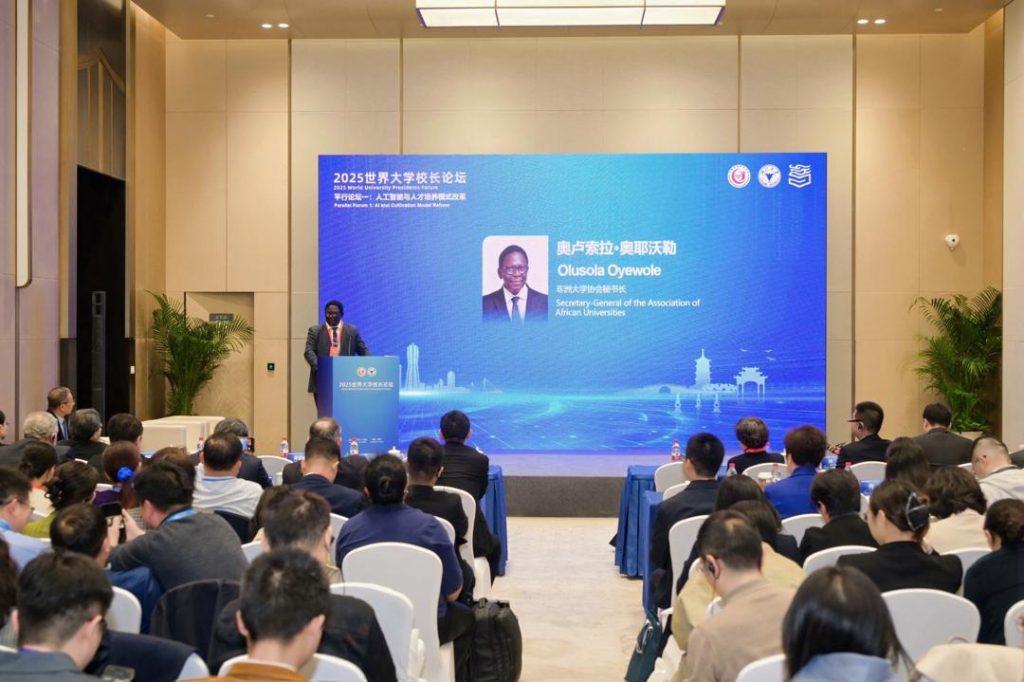
Held at the Hangzhou International Expo Center, Hangzhou, China, from November 7-10, 2025, the forums have brought together over 1,000 higher education leaders and stakeholders from over 40 countries and across five continents. The two forums are co-hosted by the China Association of Higher Education (CAHE) and the Zhejiang University under the themes “Artificial Intelligence and the Future of Higher Education” and “A Leading Country in Education and Sustainable Higher Education Development.” The AAU’s participation ensures that Africa’s immense potential is central to the global strategy for the future of higher education.
A Dual Reality: The Promise and Peril of Digital Transformation
In his keynote speech under the theme “Digital Transformation and Higher Education Equity,” Prof. Oyewole outlined the “dual reality” where digital tools act as an “elevator to new heights” for some, but a “deepening valley” for others, citing stark data by UNESCO and World Bank that nearly half of African students lack reliable internet access and in some universities, fewer than one in ten students can afford a functional digital device.
“This is not just a technological issue,” Prof. Oyewole stated. “It is a question of justice, opportunity, and human dignity.”
The Secretary-General moved beyond diagnosing the problem to charting a proactive path for Africa. He warned against a new, more complex digital divide—one defined not only by access but by skills and the meaningful use of technology. Crucially, he introduced the concept of “digital sovereignty in education,” asserting that Africa cannot be a passive consumer of foreign platforms. “We must guard against digital colonization—the silent dominance of foreign platforms that harvest our data and dictate our educational futures,” he cautioned. “Equity in the digital age means protecting the vulnerable from algorithmic bias and ensuring that technology amplifies human intelligence—not replaces it.”
Prof. Oyewole highlighted the AAU’s continental initiatives as the engine for this sovereign vision, including: The AAU Learning Management System (LMS) and African Virtual University networks; Integrating digital standards into the African Quality Rating Mechanism (AQRM) and emphasizing inclusive digital transformation and equitable access towards the achievement of the Continental Education Strategy for Africa (CESA 2026–2035).
A Clear Call to Action for Global Partners
The AAU’s address provided a concrete roadmap for achieving equity, outlining a comprehensive set of essential policy pathways. This blueprint begins with foundational infrastructure investment and calls for governments to prioritize broadband connectivity and affordable devices for students. Concurrently, it demands a cultural shift within universities towards digital skills development, ensuring digital literacy is embedded as a core competency across all academic programmes. Furthermore, the AAU is championing inclusive design as a non-negotiable principle, insisting that digital platforms be accessible to persons with disabilities, gender-responsive, and adaptable to low-bandwidth environments. To create a sustainable knowledge economy, the roadmap emphasizes strengthening ecosystems by encouraging the widespread use of open educational resources and research data sharing. Finally, it grounds these efforts in the imperative of ethical partnerships, advocating for public-private alliances that are structured to serve the public good rather than private monopoly.
Positioning Africa at the Heart of Global Collaboration
The AAU’s leadership at this prestigious forum underscores its critical role as the unifying voice for African higher education. The event, which features the launch of the “Global University AI Education and Teaching Cooperation Mechanism” and the unveiling of the Hangzhou Initiative, provided a strategic platform for the AAU to build essential partnerships. These collaborations are vital for mobilizing the resources and expertise needed to turn the vision of a digitally equitable Africa into reality.
“The true power of digital transformation lies not in the technology we adopt, but in the people, we empower,” Prof. Oyewole concluded. “Let us transform our universities not only into centres of learning, but into engines of equity, creativity, and hope. May we together build an Africa where every young person can say, ‘I belong to the digital future.’”
The Association of African Universities leveraged the platform to engage in high-level discussions and bilateral meetings with existing and potential stakeholders to advance this vital agenda for the continent. Other AAU officials present at this international platform, in addition to the Secretary General are Professor Isaiah I.C Wakindiki, Vice Chancellor, KCA University, Kenya who serves as the AAU Board member for East Africa, Professor Juliet Thondhlana, Director of the AAU’s Europe Regional Office, and Dr. Felicia Nkrumah Kuagbedzi, Acting Coordinator for ICT, Communications and Knowledge Management.