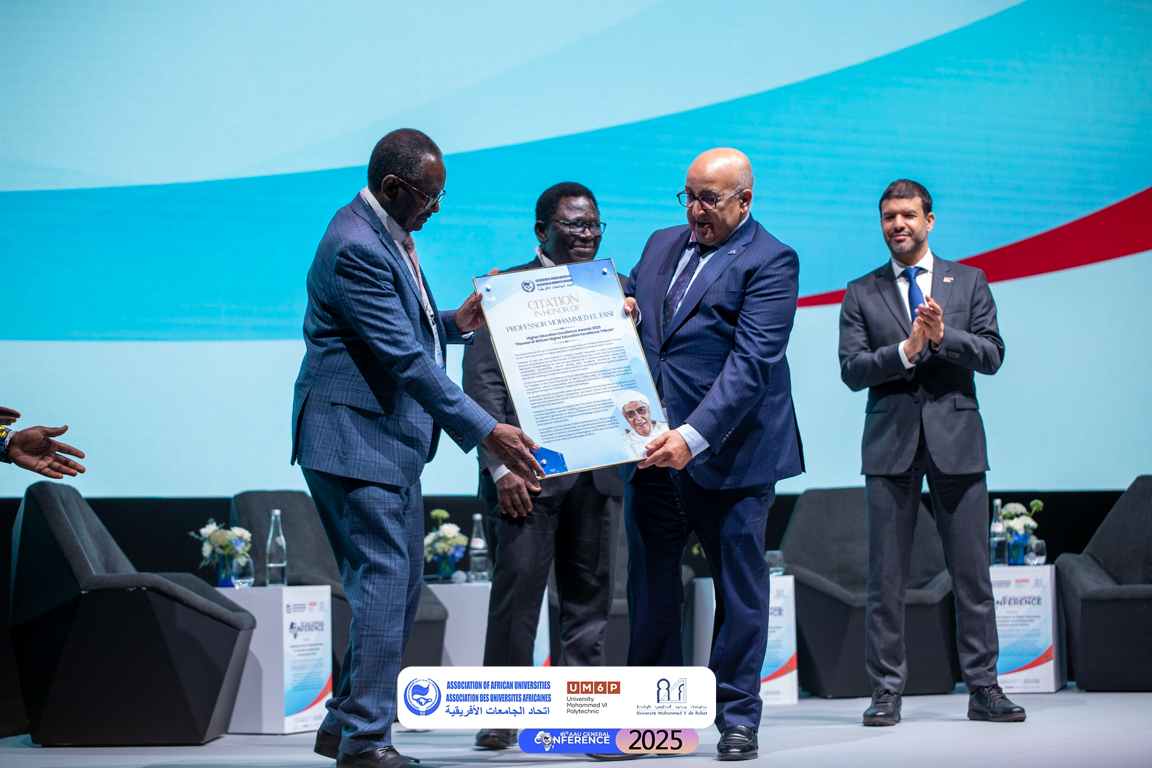
Leading lights in Africa’s higher education honoured by the Association of African Universities
July 21, 2025
African Union Charts Bold Course for Africa’s Education and Skills Future at AAU General Conference
July 21, 2025
As African universities navigate growing expectations to drive innovation, address development challenges, and prepare future-ready graduates, institutional transformation is no longer optional. It is both essential and strategic. At the 16th Quadrennial General Conference of the Association of African Universities (AAU), holding in Rabat, Morocco, from July 21 to 25, 2025, two presentations from Professor Lex Paulsen and Dr. Rachid Serraj of University Mohammed VI Polytechnic (UM6P) offered compelling insights into how universities can lead this transformation. The first, delivered by Professor Paulsen, introduced UM6P’s internal planning model, Vision 2030, which seeks to redefine institutional strategy through inclusive, bottom-up engagement. The second presentation, made by Dr. Serraj, proposed a continent-wide framework grounded in collective intelligence to foster collaboration, innovation, and long-term impact.
UM6P’s Vision 2030
Building resilient higher education institutions in Africa requires more than conventional top-down planning. It demands an approach rooted in innovation, inclusiveness, and adaptability. In a rapidly changing global environment, universities face mounting pressures to respond to complex challenges such as shifting demographics, digital transformation, disruptions of artificial intelligence, and accelerating impacts of climate change. Addressing these demands calls for institutions that are agile, inclusive, and innovation driven. It also requires new models of governance, collaboration, and knowledge production that are aligned with national priorities and Africa’s broader development agenda.
It is within this evolving context that UM6P, in 2023, conceptualized, developed, and launched its vision for 2030. The initiative was conceived as a transformative roadmap to align the university’s strategic priorities with the changing needs of Morocco and the continent. Unlike conventional institutional planning, UM6P’s Vision 2030 embraces a bottom-up approach, leveraging the collective intelligence of UM6P’s ecosystem—students, faculty, researchers, staff, and external partners—to co-create a shared vision for the future.
Emerging as a model of participatory governance, Vision 2030 was spotlighted during AAU’s General Conference under the theme “Shaping the Future of Higher Education for Innovation and Sustainable Development in Africa.” Professor Lex Paulsen of UM6P’s School of Collective Intelligence delivered an in-depth presentation, demonstrating how African universities can actively engage their communities in shaping responsive, actionable strategies.

Professor Lex Paulsen of UM6P’s School of Collective Intelligence
Institutional Innovation and Adaptive Planning
Vision 2030 is not a static strategic plan. It is a continuous learning process, a cycle of reflection, adaptation, and collaborative design. Initiated by the President’s Office, the vision is refined through annual review cycles, engagement with new opportunities, and creation of cross-departmental “experiment teams” tasked with addressing the university’s most pressing challenges. This approach ensures that Vision 2030 remains responsive, future-focused, and community-driven. Its objective is not merely to define a vision, but to shape a dynamic institutional identity that evolves over time. The initiative draws deeply on the science of collective intelligence. It combines divergent thinking to generate ideas through town halls, interviews, and workshops, with convergent thinking, which synthesizes insights, prioritizes actions, and builds consensus. This methodology promotes inclusiveness, strategic clarity, and legitimacy, enabling the university to stay aligned with both its internal aspirations and the broader external context. This initiative has contributed to UM6P’s rising global visibility, including its recognition among the top 500 universities worldwide by the Times Higher Education World University Rankings, a testament to the power of inclusive and forward-looking institutional planning, according to Khalid Baddou, Chief of Staff, UM6P and the Chair for the plenary session.
The Collective Intelligence of African Universities
Referencing UM6P’s Vision 2030 in his address, Dr. Rachid Serraj urged the participants to leverage the experiences of institutional transformation and transition the conversation to a continental scale. While African universities continue to demonstrate impressive innovations, the broader system remains constrained by fragmentation, inadequate infrastructure, and a persistent disconnect between research and real-world application.
Many institutions, he explained, lack the laboratory space and incubation facilities needed to advance prototypes. Fewer than 5% of university patents make it to the market. This disconnect not only stalls technological progress but also leaves industries across the continent struggling to find the talent and solutions they require. This challenge calls for a new model of academic cooperation, one grounded in the collective intelligence of African universities. Rather than working in isolation, institutions must align strategies that reflect Africa’s development priorities. The aim is not simply to share resources but to build integrated systems that advance knowledge production, support innovation, and prepare a workforce equipped to shape the future.
To support this ambition, UM6P proposed the establishment of an African HESTI Transformation Alliance (AHTA). The initiative envisions a pan-African framework to enhance collaboration across institutions, sectors, and borders, built around four strategic pillars of Digitally Integrated Universities, A Continental Innovation Engine, The Future Talent Force, and Policy Alignment and Harmonization.
For collaboration to succeed, enabling policies must be in place. Harmonized standards in accreditation, mobility, research governance, and intellectual property will strengthen institutional partnerships and scale sustainable impact.
According to Dr. Serraj, this alliance builds on the work already underway in institutions like UM6P. Vision 2030 stands as one institutional example. The next step is a pan-African transformation, driven by collective purpose and coordinated action.

Dr. Serraj
Converging Visions, Shaping Africa’s Future
The two presentations delivered on Day 1 of the General Conference reflect a growing shift in how African universities view their role. Universities are no longer only centers of teaching and research but are increasingly recognized as strategic actors in driving system-wide transformation. UM6P’s Vision 2030 illustrates how a university can turn inward to redefine its purpose and outward to align with national and continental goals. The proposed African HESTI Transformation Alliance builds on this experience, offering a collaborative framework for innovation, integration, and talent development across the continent.
As Africa works toward the aspirations of Agenda 2063, unlocking the collective intelligence of its universities is not only a strategic imperative. It is central to realizing the continent’s development vision. The Association of African Universities (AAU), as the convening and coordinating platform for higher education in the region, plays a critical role in advancing this agenda. By fostering dialogue, strengthening partnerships, and championing innovation in education, AAU enables institutions to move from isolated excellence to coordinated impact.
This moment calls for a shared commitment to act. Reimagining African higher education as a driver of inclusive growth and sustainable development requires collective effort. Universities, governments, industries, and communities must come together to shape a future rooted in Africa’s own knowledge systems. The foundation is in place. The time to accelerate progress is now.





1 Comment
Great contribution. Yes. Africa. We sure need to move from knowledge to action and become producers not just consumers, move from state of dependence