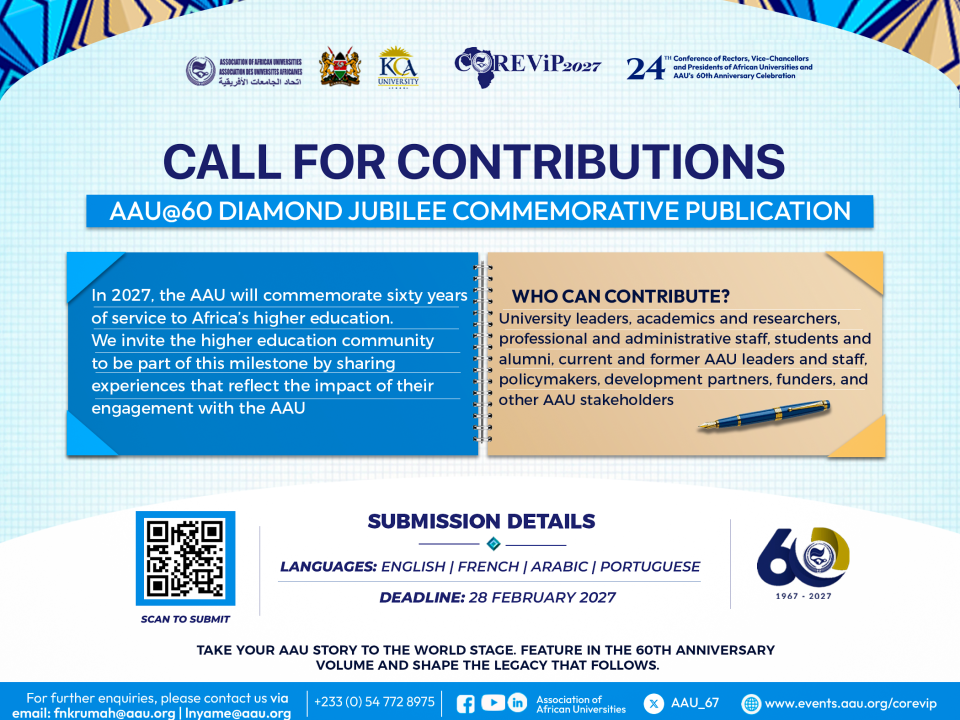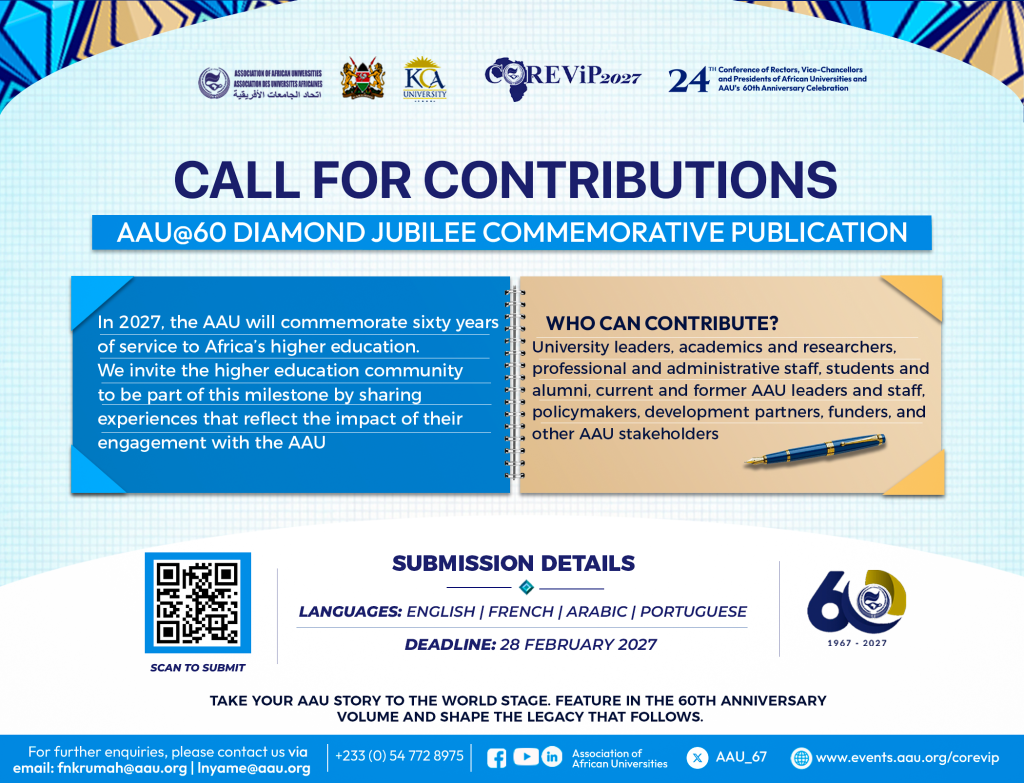
AAU@60: AAU Calls for Contributions to Diamond Jubilee Commemorative Publication
October 19, 2026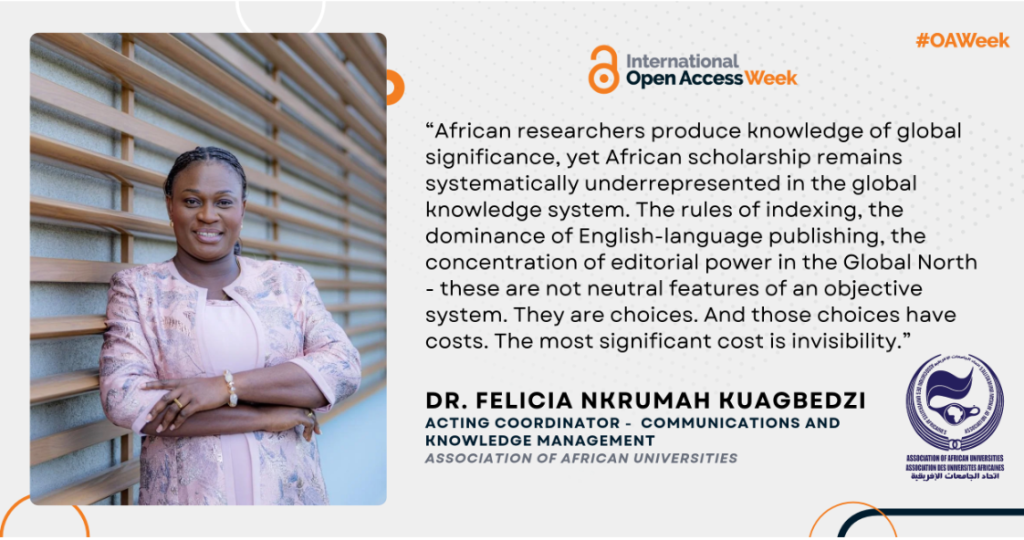
By Dr. Felicia Nkrumah Kuagbedzi, Acting Coordinator, Communications and Knowledge Management, Association of African Universities
International Open Access Week 2026 | Theme: “The Cost of Knowledge”
The Association of African Universities is pleased to mark International Open Access Week 2026 and to join the global conversation prompted by this year’s theme, “The Cost of Knowledge.” The theme invites a necessary pause and a difficult question: why do the costs of accessing and sharing knowledge continue to rise, often dramatically, and who benefits? For too long, the answer has been framed narrowly: subscription fees, article processing charges, paywalls. These are real costs. But they are not the only costs. And for Africa, they are not even the most consequential. This message reframes the conversation around the costs that remain invisible in mainstream debates: the infrastructure costs, the human costs, and the epistemic costs that Africa bears in a global knowledge system that was not designed with us in mind. It also highlights what African institutions are doing to change this: not as passive beneficiaries, but as architects of a different future.
Part One: The Cost of Invisibility
African researchers produce knowledge of global significance. They study climate resilience in the Sahel, public health interventions in East Africa, agricultural innovation in West Africa, and social transformation across the continent. This knowledge addresses not only African challenges but global ones.
Yet African scholarship remains systematically underrepresented in the global knowledge system. The reasons are structural. The rules of indexing, the dominance of English-language publishing, and the concentration of editorial power in the Global North are not neutral features of an objective system. They are choices, and those choices have costs. The most significant cost is invisibility. When African research is not indexed, it is not discovered. When it is not discovered, it is not cited. When it is not cited, it is assumed not to exist.
When African research is assumed not to exist, the world loses access to knowledge that could save lives, inform policy, and advance human understanding. This is not a hypothetical concern. It is a daily reality for thousands of African researchers whose work remains locked out of the systems that determine what counts as legitimate knowledge.
Part Two: The Infrastructure Cost
There is another cost that must be named: the cost of the infrastructure that makes open science possible. This includes the repositories, indexing services, persistent identifiers, metadata systems and publishing platforms that turn open science ideals into functioning reality. These systems are largely non-commercial. They are underfunded. And they are vulnerable. When they falter, or when they are absorbed by commercial platforms, the cost is borne disproportionately by institutions and countries with the least capacity to absorb it.
Three African examples illustrate the point:
- The African Open Science Platform, launched in 2017, aims to coordinate and amplify open science across the continent, building shared capacity, developing shared infrastructure, and positioning African scientists at the cutting edge of data-intensive science.
- African Journals Online (AJOL) has long worked to make African research accessible to African researchers and to the world. It is a public good, but it requires resources to operate, and like many open infrastructures, it operates on a fraction of what commercial publishers extract from the same scholarly ecosystem.
- AfricArXiv provides a locally hosted repository for African preprints, data and code, ensuring that African research is not only visible but owned by African institutions.
These are not marginal initiatives. They are the backbone of a different kind of knowledge system, one that treats knowledge as a commons rather than a commodity. But they need investment: sustained, predictable, collective investment.
This is why the AAU strongly aligns with the work of the Global Sustainability Coalition for Open Science Services (SCOSS), a network of influential organisations committed to securing open access and open science infrastructure well into the future. Through our position on the SCOSS Board, represented by Dr. Felicia Nkrumah Kuagbedzi, the AAU contributes to identifying non-commercial services essential to open science and to making qualified recommendations on which of these services should be considered for funding support. Only non-commercial services on fragile financial footing are eligible.
Part Three: The Human Cost
There is a third cost that must be named: the human cost of a system that extracts value from those who can least afford to give it. Open science in Africa depends on the labour of editors, reviewers and journal managers who work largely without compensation. They sustain journals that serve their communities, their disciplines and their continent, not because they are paid to do so, but because they believe in the mission. This is a subsidy: a subsidy from African scholars to a global system that often refuses to recognise their contribution.
The ALMASI Landscape Report on Diamond Open Access publishing across Africa, Europe and Latin America has documented this clearly. Diamond OA publishing “suffers from a strong dependence on volunteer labour that is often unrecognised and unrewarded.” Combined with the absence of academic incentives for publishing in or managing Diamond OA journals, this creates weaknesses in continuity, quality and scalability. The journals exist because people care. But caring is not a sustainable funding model.
Part Four: What Africa Is Building
This is not a story of deficit. It is a story of agency. Across the continent, African institutions are building the infrastructure, policies and practices that a different knowledge system requires. Diamond Open Access, publishing that charges no fees to readers or authors, is flourishing in Africa. Countries such as Algeria host large Diamond OA journals on national platforms. Ethiopia provides free hosting, DOIs and training through Ethiopian Journals Online. Nigeria’s Tertiary Education Trust Fund supports journal publishing costs directly.
The African Platform for Open Scholarship is building a tenant model for decentralised hosting, empowering universities to publish rigorous journals and books under African governance. The AAU, through the African Research Innovation and Development (AfRID) network, an initiative Connecting African Scholars, Institutions & Research Communities programme, operates a comprehensive platform for academic networking, research tracking and collaboration across Africa.
In partnership with the African Library and Information Associations and Institutions (AfLIA) and SPARC Africa, the AAU will co-host a continental virtual conference on Diamond Open Access (DOA). The conference will convene university leadership, librarians, ICT directors, researchers, journal editors, publishers, policymakers, development partners and open science practitioners from across Africa and the Global South. https://workshops.aau.org/Virtual-Diamond-Open-Access-Conference
Taking place 2 to 5 November 2026, the conference builds on the outcomes of the Second Global Summit on Diamond Open Access and the Toluca-Cape Town Declaration, of which the AAU was the first signatory, underscoring the Association’s commitment to transforming research dissemination across the continent. It seeks to move the Diamond Open Access conversation from advocacy to implementation, developing practical strategies that strengthen Africa’s capacity to create, disseminate and preserve scholarly knowledge through academy-owned systems.
The AAU is also partnering with key institutions, including PLOS and TCC Africa, to convene Vice-Chancellors and senior leadership from across the continent to advance institutional open science mandates.
Part Five: The Policy Imperative
Infrastructure alone is not enough. Without policy, infrastructure is a library without readers. Across Africa’s universities, only a small fraction have adopted open access mandates. This is the gap we must close. The UNESCO Recommendation on Open Science, adopted by 193 countries in 2021, provides a framework. It calls on member states to invest in open science infrastructure, align incentives for open science, and promote equitable participation.
The AAU calls on African universities to translate these commitments into institutional policy:
- Adopt open science mandates;
- Revise promotion and tenure criteria to recognise open publishing;
- Allocate resources to sustain the infrastructure we depend on.
This is not about compliance. It is about ownership.
Conclusion: The Cost We Choose to Bear
The costs of the current system are real. They are financial. They are human. They are infrastructural. And they are borne disproportionately by those who have the least power to change the system from within. But there is another cost we must consider: the cost of not building something different.
- The cost of continuing to depend on infrastructure we do not control.
- The cost of continuing to accept evaluation systems that were not designed for us.
- The cost of continuing to treat knowledge as a commodity when it should be a commons.
The choice before us is not whether to bear costs. It is which costs we choose to bear, and who bears them. Africa’s position is clear. We choose to bear the costs of building our own infrastructure. We choose to bear the costs of sustaining our own journals. We choose to bear the costs of policy reform and capacity building.
Because the alternative, continuing to pay for access to knowledge we produced, in systems we do not govern, is a cost we can no longer afford.