
Safety and Security in African Universities Workshop

- This event has passed.
Safety and Security in African Universities Workshop
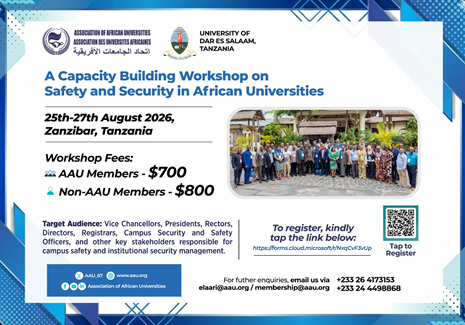
Workshop on Safety and Security in African Universities
“Managing Security and Safety Threats in African Universities and Colleges: Mitigation Strategies for the 21st Century”
As part of the Association of African Universities (AAU)’s commitment to delivering value to its members and advancing higher education in Africa, the AAU in collaboration with the University of Dar es Salaam, is organizing a strategic workshop on Safety and Security in African Universities under the theme, “Managing Security and Safety Threats in African Universities and Colleges: Mitigation Strategies for the 21st Century”.
This initiative seeks to educate, enlighten, and enhance administrators, leaders, students and university communities’ consciousness of the existing and emerging security challenges that university communities face. It also seeks to increase and strengthen the capacity of leaders and the entire university communities to appreciate, prevent and contain, in a timely and holistic manner, threats as they arise. Safety, security, and the psychological health of faculty, staff and students are critical and foundational to academic success and institutional resilience globally (Chaudary et al, 2024). African universities and their communities are particularly faced with diverse security challenges. African universities are often buffeted by violent protests (like FeesMustFall in South Africa), gender-based violence, theft, terrorism threats, political violence, cybercrime and other forms of threats (Dlamini & Olarewaju, 2021; Mkhize et al., 2022). These threats need urgent and effective security policies and measures through digital innovations while fostering collaborative, community-driven safety models. The safety and security in African universities needs multiple approaches that integrates physical infrastructure, digital tracking, and joint community strategies (Moghayedi, 2024; Gallagher Content Team, 2024). Prioritizing safety, security, and psychological well-being in University communities guarantees a flourishing academic basis for higher retention ratios, enhanced cognitive performance, a resilient campus culture and better management of stressors. This workshop is one in a series that endeavours to tackle these challenges by empowering institutions with the resources and techniques needed to protect students, staff, assets and university communities efficiently.
OBJECTIVE
The workshop aims to train African university security personnel and build resilient, modern security procedures to safeguard academic communities, protect institutional resources, and produce peaceful, conducive environments indispensable for higher education and Africa’s development. Specifically, the workshop seeks to:
- Enhance the knowledge and skills of security personnel, enabling them to design and implement advanced access control systems, effectively leveraging cutting-edge
- technology.
- Emphasize the importance of adopting proactive security policies, including regular safety audits, emergency preparedness drills, and clear communication channels for incident reporting.
- Promote a collaborative approach involving students, faculty, and administration to foster a safer campus environment.
GOALS
Specific goals of this workshop includes:
- Improving Capacity and Professionalism: Empowering campus security officers with enhanced skills in intelligence collection, crime scene management, emergency response, and evidence gathering.
- Safeguarding Students and Assets: Safeguarding university communities, academic buildings, and student accommodation (both on and off-campus) against violence, pilfering, and unauthorized access.
- Promoting a Culture of Collective Responsibility: Transitioning basic securing by advancing campus-wide consciousness and training programs like University of Ghana’s “Safety and Security Champions” creativities to involve students in vigilance and emergency alertness.
- Transforming Security Structure: Moving from conventional, manual patrols to amalgamated, modern systems figuring CCTV surveillance, electronic access management, and fast emergency communication systems.
- Preventing Emerging Threats: Containing 21st-century hazards like cybersecurity breaches and academic fraud to protect the integrity of the institution’s information technology and student records.
This workshop will cover essential topics such as personal safety and awareness, emergency response and evacuation procedures, cybersecurity and data protection, conflict resolution and de-escalation techniques, first aid and CPR training, and asset-cycle management.
WORKSHOP STRUCTURE
Security is conceptualised as a multi-dimensional issue and covered through an intensive 3-day session. The following dimensions of security will be addressed as part of the workshop.
Physical Security and Environment Design
- Access control: Control of entry and exit points, including gates, doors, and barriers.
- Surveillance: Use of CCTV cameras, alarms, and sensors to monitor campus activity.
- Lighting: Crime Prevention Through the Environment Design (CPTED): improving campus lighting and access controls, including walkways, parking lots, and buildings.
- Barriers and fencing: Physical barriers to prevent unauthorized access.
- Training frontline security personnel on de-escalation, conflict management, and lawful interventions.
Personal Security
- Emergency response planning: Plans and procedures for responding to emergencies, such as fires, medical emergencies, and violent incidents.
- Crisis intervention and support: Support services for students, faculty, and staff affected by crisis or trauma.
- Self-defense training: Training programs for students, faculty, and staff on self-defense techniques.
- Support for vulnerable populations: Specialized support services for vulnerable populations, such as international students, and students with disabilities.
Gender-Based Violence (GBV) and Mental Health
- Establishing safe reporting mechanisms, victim support protocols, and first-responder training for security staff.
- Promoting a culture of consent, awareness campaigns, and safe-space development.
Cybersecurity and Data Protection
- Network security: Protection of campus networks from cyber threats, including hacking, malware, and phishing.
- Data protection: Protection of sensitive data, including student records, research data, and financial information.
- Incident response: Plans and procedures for responding to cybersecurity incidents.
- Awareness and training: Training programs for students, faculty, and staff on cybersecurity best practices.
Environmental Security
- Disaster preparedness: Plans and procedures for responding to natural disasters, such as earthquakes, hurricanes, and floods.
- Environmental health and safety: Monitoring and mitigation of environmental hazards, including air and water quality.
- Sustainability initiatives: Initiatives to reduce campus environmental impact, including energy efficiency, waste reduction, and recycling.
- Emergency response planning for environmental incidents: Plans and procedures for responding to environmental incidents, such as chemical spills or wildfires.
Community Security
- Community engagement: Building relationships between campus security and local law enforcement, community organizations, and neighborhood residents.
- Crime prevention through environmental design (CPTED): Designing campus spaces to prevent crime, including natural surveillance, access control, and territorial reinforcement.
- Student involvement in security initiatives: Involving students in security initiatives, including student patrols, security awareness campaigns, and crisis response teams.
- Partnerships with local law enforcement: Collaborations with local law enforcement agencies to enhance campus security.
Politicisation of University Administration and Student Leadership
- Political interference and the politicization: Universities compromise campus security by undermining recognised autonomy, weakening neutral law enforcement, and changing academic settings into arenas for national or parochial interests.
- Weaponisation of factional student groups: State security forces may be weaponized to silence opposing student groups or vocal faculty under the guise of maintaining order, resulting in human rights violations and targeted harassment.
- Proxy Campus Battles: Direct ties between national political parties and campus factions often result in fierce, sometimes violent, proxy battles over student leadership positions
- Vulnerability: This dynamic threatens safety by shifting the focus from education to political conflict.
Violent Extremism/ Terrorism and Radicalisation
- Ideological Radicalisation: Violent extremism and terrorism imperil universities by threatening faculty, staff, and students’ security, undermining academic openness, and sparking ideological radicalization.
- Indoctrination and recruitment: Radical groups actively exploit youth grievances and structural socio-economic vulnerabilities to recruit and indoctrinate within academic communities.
- Targeted Violence: Groupings like Boko Haram and Al-Shabaab have usually targeted campuses, leading to kidnappings, carnages, and the ruin of educational infrastructure.
- Displacement: In sub-regions like the Sahel, militant invasions have compelled universities to halt classes, relocate, or shift wholly to online learning, harshly disrupting education.
- Resource Competition: Transhumance groups such as the Fulani in Nigeria have forced large displacements by overrunning university campuses.
Gangs and Occultism in Universities
- Drug and Weapons Trafficking: Gangs endanger university security chiefly through violent initiations, extortion schemes, organized theft, and drug trafficking, which undermine the safety of both campuses and surrounding student communities
- Violent Initiations and Cultism: In many regions, particularly across West Africa, like the Black Axe in Nigeria use universities as key enlistment grounds, endangering new initiates to rigorous physical violence, black magic rites, and obliged criminality
- Campus Intimidation: The manifestation of armed gang members results in a climate of anxiety, choking academic freedom, disordering campus governance, and heightens the risk of toxic violent conflicts.
Epidemics and Pandemics
- Death and morbidity: Epidemics and pandemics posse a grave threat to universities communities, given the dense populations, high mobility and contact among staff and students, and propensity of pathogens to spread rapidly.
- Vulnerabilities: Epidemics and pandemics worsen socio-economic disparities, drain institutional finances, and impede global mobility, revealing deep-seated weaknesses in the continent’s higher education sector.
- Digital Gap and Study Disruption: The fast change to crisis remote teaching revealed a major structural weakness, high cost of data, lack of electricity, the deficiency of readiness for extensive online learning. Effecting rural and lower-income students critically deprived.
- Institutional Financial Uncertainty: Many universities are greatly reliant on tuition and accommodation fees, and lengthy quarantine and university shutdowns lead to massive income losses, compelling universities into recruitment embargoes, staff redundancy, threats to staff and career progression, and slashes in vital educational and sustenance services.
- Inertia of Internationalization: Plagues impede international academic movement, restraining the mobility of international students, scholars, and student exchange programs; negatively impacting the cultural richness of universities and the income produced by international admissions.
Crisis Management and Emergency Evacuation
- Crisis Management: Preparing or designing response strategies for civil strife, natural disasters, and medical emergencies such as epidemics and pandemics.
- Contingency Planning: Collective disaster planning, communication strategies, and collaboration with local law enforcement such as the Police.
Engagement Tools (Case Study/Role Play)
- Role-playing de-escalation scenarios and mapping physical vulnerabilities on actual campus blueprints are sessions incorporated as practical.
WORKSHOP FORMAT
The workshop has adopted a strategic methodology which will include effective approaches, such as the use of case studies, focused group discussions, experiential learning (Case studies from universities in the various regions in Africa), presentations and sharing of ideas, knowledge and skills. The workshop will develop a follow-up process to ensure that university Management are implementing the good practices to be learned from the workshop at their various institutions of higher learning. Participants will have the opportunity to engage in dialogue with peers on the various challenges at their universities and strategies to overcome them. A postworkshop report will be compiled, and recommendations made will be integrated into improving subsequent workshops.
TARGET GROUP
The workshop is designed for key decision-makers and stakeholders, including: Vice Chancellors, Presidents, Rectors, Directors, Registrars, Campus Security and Safety Officers, and other Professionals responsible for formulating and implementing security policies
WORKSHOP DETAILS
Main Workshop Dates: 25th – 27th August, 2026.
Venue: Golden Tulip, Zanzibar
Workshop Host: University of Dar es Salaam
FEES:
- AAU Members- $700
- NON-AAU Members- $800
- Institutions in Tanzania (subsidized fee)-$600
Registration covers the conference package including training materials, certificates, tea/coffee, and lunches for the three-day workshop. Participants will be responsible for their air tickets, Visa fees, accommodation and dinners .
To register kindly click on the link below: https://forms.cloud.microsoft/r/NxqCvF3vUp
TRAVEL, ACCOMMODATION, AND VISA
The Association of African Universities (AAU) will provide registered delegates with an official invitation letter issued through the host university and the Foreign Ministry of Tanzania upon completion of the registration process. This invitation letter will support delegates in obtaining a visa on arrival in Zanzibar, Tanzania, where applicable.
Participants are advised to verify the visa requirements applicable to their nationality and apply for their visas through the official Tanzania Immigration Department website or the online Tanzania eVisa portal. Tanzania Immigration Department Visa Information or the online visa application portal: Tanzania eVisa Portal.
RECOMMENDED HOTELS
| HOTEL | COST PER NIGHT | CONTACTS FOR BOOKING |
| Golden Tulip Zanzibar (Workshop Venue)
|
150 USD | rez@goldentulipzanzibarairport.com |
| 27 Cafe Zanzibar Airport Hotel
|
65 USD | airporthotel27cafe@gmail.com |
| Golden Palm Boutique Zanzibar
|
95 USD | reservations@goldenpalmzanzibar.com |
| Wellworth Zanzibar Beach Resort | 135 USD | crm@wellworthgroup.com |
CONTACT DETAILS – elaari@aau.org and copy membership@aau.org or WhatsApp +233-244498868.
LANGUAGE:
The main training language is English.
STUDY TOUR
- University of Dares salam
- Zanzibar University
A BRIEF BACKGROUND OF THE AAU
The Association of African Universities (AAU) founded in 1967 with an initial membership of 34 universities, currently has over 400 member institutions spread across 46 African countries. The Association represents the voice of higher education in Africa and draws its membership from all five sub-regions of Africa and operates in four official languages, namely English, French, Portuguese and Arabic. The Association’s mandate as an apex organization for higher education in Africa is to promote cooperation, academic linkages and exchange of information on higher education issues across the continent. The mandate further extends to support members in their core functions of teaching, learning, knowledge generation and its dissemination through fundamental and applied research and community engagement. The AAU also plays a key role in setting up dialogue platforms, advocacy and raising awareness for and about the major needs of African higher education institutions and coordinates how these needs are met. The Association also acts as a catalyst for increased networking between and among its members and the wider African and international higher education academic community. In pursuit of its mandate, AAU coordinates and facilitates one of the World Bank’s biggest Education Projects; the Africa Higher Education Centres of Excellence (ACE) Project. The AAU also serves as the Coordinator for the Continental Education Strategy for Africa (CESA), among other high-profile projects and initiatives. The AAU frequently identifies areas where member institutions require capacity building through its training programmes that are tailor-made to address such needs.
REFERENCES
Blokland, P. & Reniers, G. (2020). Exploring the Interrelations Between Safety and Security.
Chaudhry, S., Tandon, A., Shinde, S., & Bhattacharya, A. (2024). Student psychological well-being in higher education: The role of internal team environment, institutional, friends and family support and academic engagement. PloS one, 19(1), e0297508. https://doi.org/10.1371/journal.pone.0297508
Cybersecurity Education Recommendations. (2022). Journal of Cybersecurity Education, Research and Practice.
Dlamini, N. & Olarewaju, O.A. (2021). An Investigation into Campus Safety and Security. Proceedings of the 11th Annual International Conference on Industrial Engineering and Operations Management Singapore, March 7-11, 2021
Edwards, F.L. & Goodrich, D.C. (2021). Emergency Management, Safety, and Security. In: Global Encyclopedia of Public Administration, Public Policy, and Governance. Springer.
Gallagher Content Team. (Blog, Tuesday 9, 2024). How to Improve Campus Security for a Secure Learning Environment. In: Safety and Security Management. Springer.
Lebitse, P. (2019). Sowetan Live. [Online] Available: https://www.sowetanlive.co.za/amp/opinion/columnists/2019-02-12-alarming-that-safety-on campus-remains-elusive/ Accessed on: 28 June, 2026.
Manyathela, C. (2018). Eyewitness News. [Online] Available at: https://ewn.co.za/2019/07/11/saps-considered-most-corrupt-institution-in-sa-survey. Accessed on: 28 June, 2026.
Mkhize, S., Cinini, S.F. & Ngcece, S. (2022). University campuses and types of crime: A case study of the University of KwaZulu-Natal/Howard campus in the city of Durban-South Africa, Cogent Social Sciences, 8:1, 2110199, DOI: 10.1080/23311886.2022.21101
Moghayedi, A., Michell, K., Le Jeune, K., & Massyn, M. (2024). Assessing the influence of technological innovations and community-based facilities management on the safety and security of universities. A case study of an open campus. Facilities, 42(3-4), 223-244.
