AAU International Women’s Day 2026 Commemoration

- This event has passed.
AAU International Women’s Day 2026 Commemoration
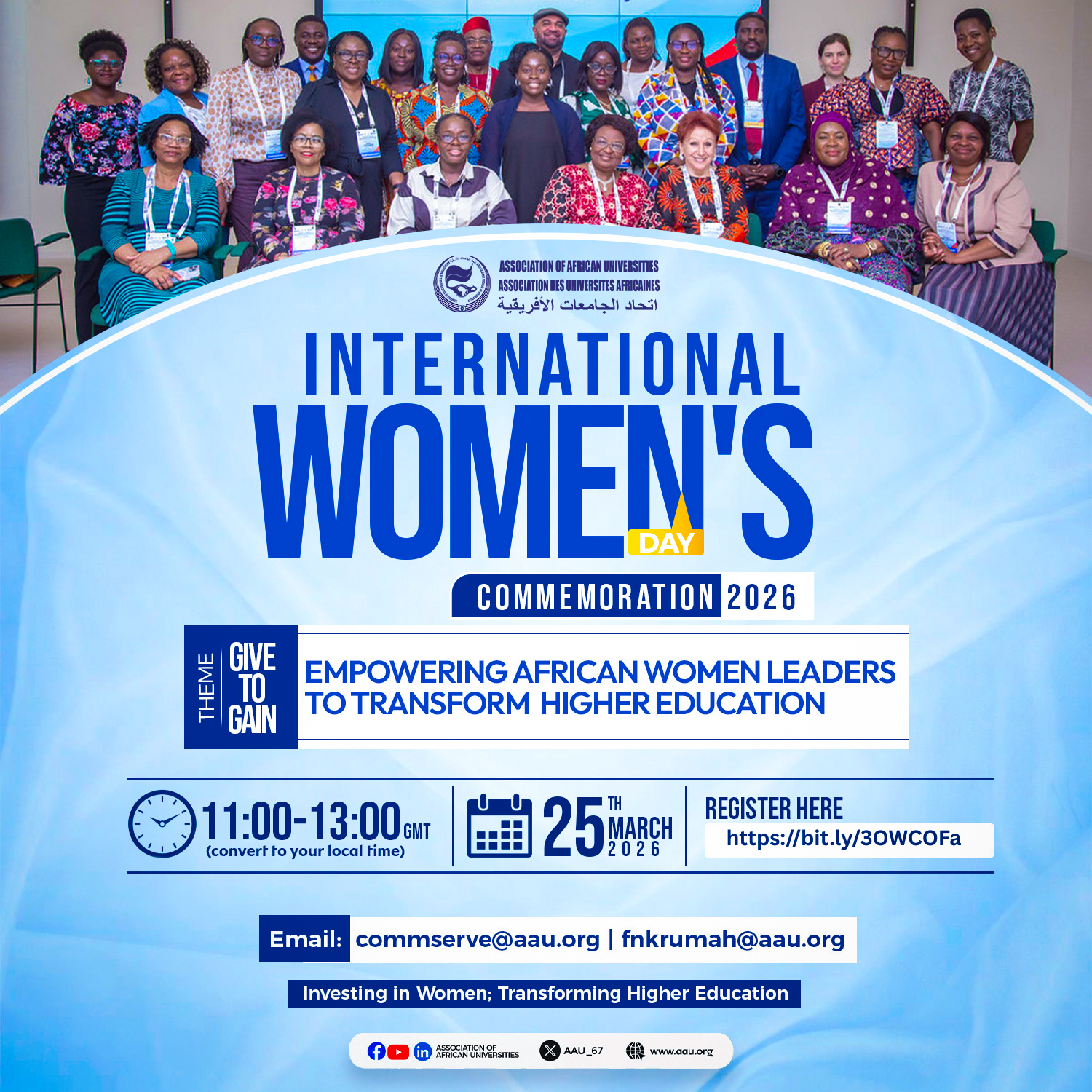
EMPOWERING AFRICAN WOMEN LEADERS TO TRANSFORM HIGHER EDUCATION: A Strategic Imperative for Institutional Excellence and Continental Development
Event: AAU International Women’s Day 2026 Commemoration
Date: 25th March 2026 | Duration: 2 Hours
Time: 11:00 GMT – 13:00 GMT
Theme: Give to Gain: Empowering African Women Leaders to Transform Higher Education
Format: High-Level Keynote Address followed by Expert Panel Discussion
Registration: Open to all higher education stakeholders via online link
-
EXECUTIVE OVERVIEW
The Association of African Universities (AAU) cordially invites all higher education stakeholders – from Vice-Chancellors and university executives to faculty members, administrative staff, researchers, students, and development partners – to its 2026 International Women’s Day commemoration under the theme: “Give to Gain: Empowering African Women Leaders to Transform Higher Education.” This high-level convening transcends celebratory rhetoric to address a fundamental strategic question: How can African higher education institutions deliberately invest in women’s leadership as a catalyst for institutional transformation, research excellence, and continental development?
Scheduled for two hours on 25th March 2026, the event will feature a thought-provoking keynote address by a distinguished African woman university leader, followed by a dynamic panel discussion with prominent women Vice-Chancellors and senior academics from across the continent. The format is deliberately designed to generate actionable insights and institutional commitments that will shape the trajectory of gender-transformative leadership in African higher education. Registration is open to all interested stakeholders via this online link, reflecting the AAU’s commitment to inclusive dialogue and broad-based engagement in advancing women’s leadership.
-
STRATEGIC CONTEXT: THE IMPERATIVE FOR TRANSFORMATIVE ACTION
African higher education stands at a critical juncture in the continent’s development trajectory. As African Union Member States accelerate toward Agenda 2063 and the Sustainable Development Goals, universities must function as powerful engines of innovation, knowledge production, and transformative leadership capable of addressing the continent’s most pressing challenges. Yet the persistent underrepresentation of women in academic leadership represents not merely an equity concern requiring redress, but a significant and measurable drag on institutional performance, research productivity, and continental potential that African nations can ill afford. This reality affects every member of the university community – from governing council members to junior researchers, from finance officers to student leaders – and therefore demands the engagement of all stakeholders in crafting and implementing solutions.
The theme “Give to Gain” encapsulates a powerful statement for university leaders, governing councils, development partners, and indeed all members of the university community. Strategic investment in women’s leadership development – through targeted mentorship programmes, equitable funding mechanisms for research and advanced training, deliberate policy reforms to recruitment and promotion processes, family-friendly institutional policies, sustained leadership development initiatives, and inclusive institutional cultures – yields measurable and substantial returns in institutional excellence, research productivity, and developmental impact. When universities give through intentional investment in women’s advancement, they gain stronger governance systems characterized by more robust deliberation and better decisions. They gain more innovative research enterprises producing scholarship that addresses the full range of societal challenges. They gain more effective institutional leadership reflecting the diversity of their academic communities, and they gain enhanced reputation and legitimacy as institutions genuinely committed to excellence and equity in equal measure.
Contemporary research across diverse global contexts establishes unequivocally that gender-diverse leadership correlates with superior institutional outcomes. When women are adequately represented in senior academic ranks, university executive positions, and governance structures, institutions demonstrate enhanced performance across multiple dimensions. Inclusive leadership teams bring broader perspectives to complex problem-solving, challenge groupthink in strategic decision-making, and more accurately reflect the student populations they serve. In the research domain, diverse teams produce more innovative scholarship with greater citation impact and broader societal relevance, while women’s leadership in academia positively influences student outcomes, particularly for female students who benefit from visible role models and intentional mentorship, thereby strengthening the entire educational pipeline from undergraduate enrolment through doctoral completion and into academic careers.
-
OVERARCHING OBJECTIVES
This high-level commemoration is designed to achieve five interconnected strategic objectives that collectively advance the AAU’s mission of promoting excellence and collaboration in African higher education while catalyzing tangible progress toward gender-transformative leadership across the continent:
First, Thought Leadership and Agenda Setting: The event will position the Association of African Universities and its member institutions at the forefront of global discourse on gender-transformative leadership in higher education. By convening the continent’s most distinguished university leaders alongside faculty, staff, students, and partners around evidence-based dialogue, the AAU signals that women’s leadership advancement is not a peripheral concern but a core strategic priority for institutional excellence and continental development requiring the engagement of all stakeholders.
Second, Evidence-Based Dialogue and Knowledge Exchange: The conversation will be deliberately elevated from advocacy and aspiration to rigorous examination of evidence: what interventions have proven effective in advancing women’s leadership across diverse African contexts, why they work, under what conditions, and at what cost. Participants from all corners of the university community will share institutional experiences, learn from successes and failures across the continent, and develop nuanced understanding of the pathways to meaningful change.
Third, Institutional Commitment and Accountability: A central objective is securing concrete policy commitments from participating Vice-Chancellors and university leaders toward gender-responsive leadership development within their institutions, while also engaging faculty, staff, and students in holding their institutions accountable for progress. These commitments may take various forms including specific targets for women’s representation in senior roles, reforms to recruitment and promotion processes, establishment of mentorship programmes, allocation of dedicated resources, family-friendly policy reforms, or public statements of institutional priority.
Fourth, Partnership Mobilization and Resource Catalysis: The convening will catalyse new funding partnerships and collaborative initiatives supporting women scholars and leaders across the continent. By bringing the full range of higher education stakeholders together with development partners, philanthropic foundations, and international funders in structured dialogue, the event creates conditions for meaningful partnership formation that can support continental-scale initiatives.
Fifth, Network Strengthening and Community Building: The event will deepen the continental network of women leaders and their allies across all institutional roles through structured engagement and planned follow-up action, sustaining ongoing collaboration, mentorship, and mutual support long after the event concludes.
-
PROGRAMME STRUCTURE
Recognizing the demanding schedules of higher education stakeholders and the importance of broad-based engagement, the event is designed for maximum intellectual impact and meaningful participation within a compressed but substantive timeframe. All sessions will be delivered virtually with interactive features enabling broad participation.
| Time | Session | Duration | Purpose and Content |
| 0-10 mins | Welcome and Strategic Framing | 10 minutes | Official welcome by AAU Senior Leadership setting the strategic context for the conversation |
| 10-35 mins | Keynote Address | 25 minutes | Delivered by a distinguished African woman university leader of international standing, focusing on “The Leadership Imperative: Why Women’s Advancement is Non-Negotiable for Institutional Excellence” |
| 35-80 mins | High-Level Panel Discussion | 45 minutes | Moderated by a senior academic with deep expertise in gender and higher education policy, featuring 3-4 distinguished women Vice-Chancellors/ senior university leaders from diverse African regions |
| 80-105 mins | Open Dialogue and Audience Engagement | 25 minutes | Structured engagement with all participants through virtual platforms, enabling stakeholders to contribute perspectives and share institutional experiences |
| 105-120 mins | Closing Remarks and Call to Action | 15 minutes | Synthesis of key insights, announcement of follow-up mechanisms and closing by AAU leadership |
-
TARGET AUDIENCE
In keeping with the AAU’s commitment to inclusive dialogue and broad-based engagement in advancing women’s leadership, this event welcomes all higher education stakeholders who share an interest in creating more equitable, excellent, and transformative African universities. The diversity of perspectives and experiences represented will enrich the dialogue and strengthen collective capacity for transformative action.
Invited participants include:
- Vice-Chancellors and University Presidents
- Deputy Vice-Chancellors, Registrars, and Senior Administrators
- Deans, Heads of Department, and Academic Managers
- Faculty Members and Academic Researchers
- Administrative and Professional Staff
- Early-Career Academics and Postdoctoral Researchers
- Graduate and Undergraduate Students
- Government and Ministry Officials
- Development Partners and International Funders
- Philanthropic Foundations
- Civil Society Organizations and NGOs
- Media and Communications Professionals
- Male Allies Across All Roles
- Professional Associations and Networks
This inclusive approach reflects the AAU’s understanding that transformative change requires the engagement of all members of the university community. Senior leaders cannot implement change alone; faculty members cannot create inclusive cultures in isolation; administrative staff cannot transform institutional practices without support; students cannot advocate effectively without allies; and external partners cannot invest wisely without understanding institutional realities.
-
ANTICIPATED OUTCOMES
The success of this high-level convening will be measured not by the quality of the conversation alone, but by the concrete actions, institutional commitments, and measurable progress that follow. The AAU is committed to ensuring that the energy and insights generated during this event translate into sustained momentum for change across the continent.
Immediate outcomes will include documentation and dissemination of key insights, institutional commitments, and partnership opportunities through a synthesis report distributed to all registered participants and made available to the broader AAU membership. The recording of the event will be made available to all registrants, enabling those unable to attend live to benefit from the dialogue, while media coverage and social media amplification will extend the reach of the conversation beyond those who participated directly.
Long-term impact includes measurable progress in women’s representation in senior academic and governance positions across AAU member institutions, enhanced research productivity and innovation capacity through more inclusive knowledge production, stronger continental networks sustaining women’s leadership development through ongoing mentorship and collaboration, and the embedding of normative shifts recognizing women’s leadership as a strategic imperative in institutional discourse, policy frameworks, and resource allocation decisions across the continent.
-
REGISTRATION AND PARTICIPATION
All higher education stakeholders are warmly invited to participate in this important continental dialogue. Registration is open via the dedicated online link, which will be widely disseminated through AAU communications channels, member institution networks, partner organizations, and social media platforms. There is no fee for participation, reflecting the AAU’s commitment to broad-based engagement in advancing women’s leadership.
-
CONTACT INFORMATION
For registration, expressions of interest, partnership opportunities, or additional information, email:
commserve@aau.org with a copy to fnkrumah@aau.org
