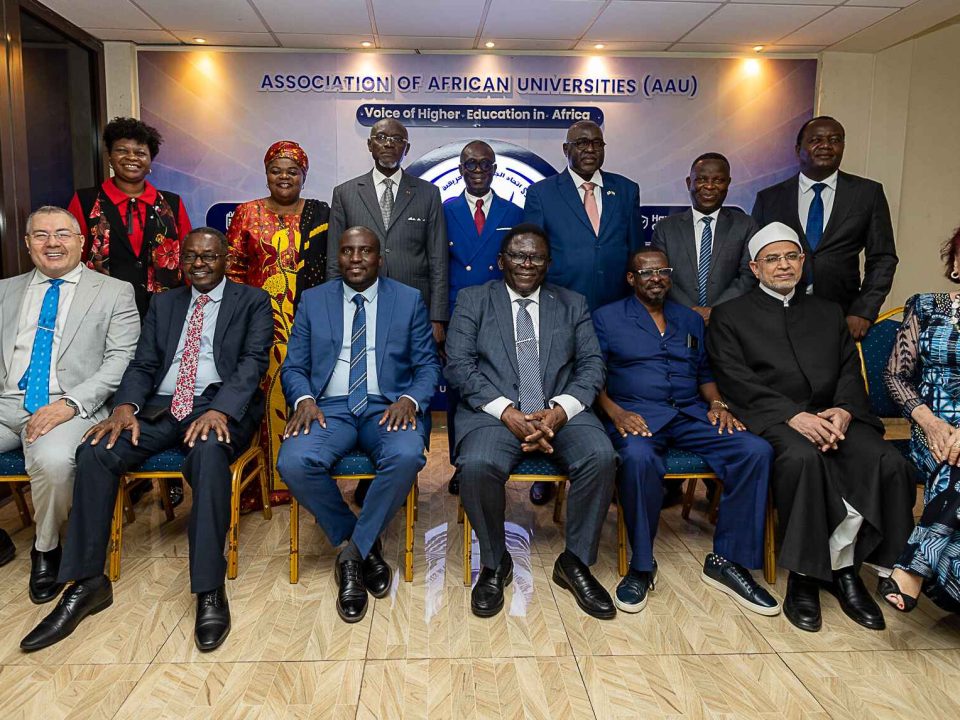

AAU Governing Board Convenes in Accra to Advance Strategic Priorities and Strengthen Africa’s Higher Education Agenda
February 13, 2026
Vacancy for a Head of Information Technology (IT)
February 25, 2026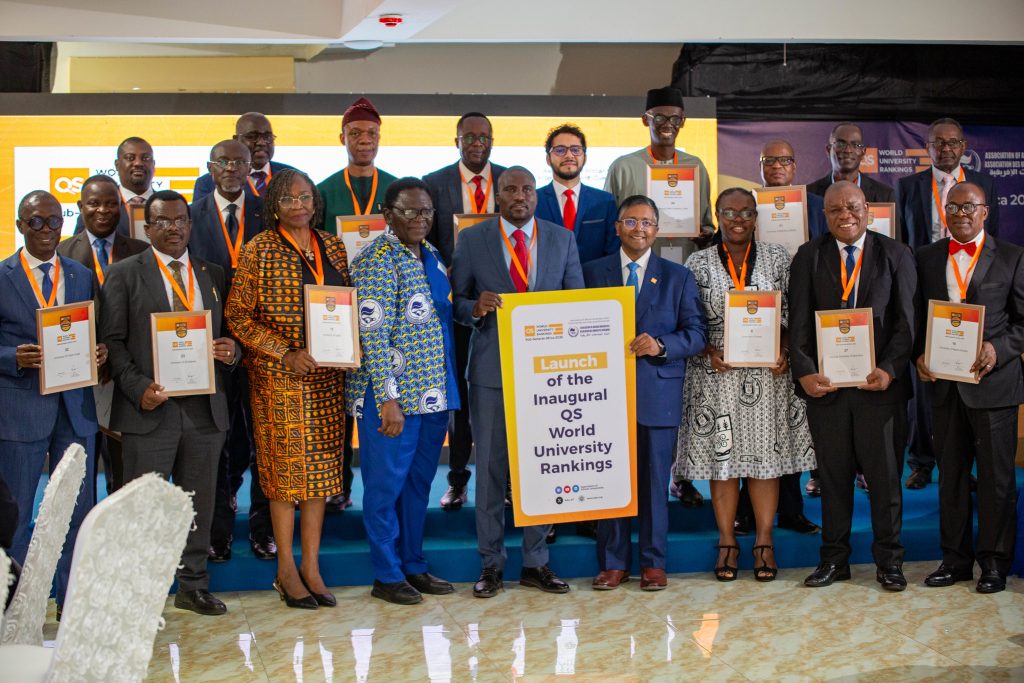
As Sub-Saharan Africa expands its higher education capacity amid rapid demographic growth, the measurement of institutional performance has become increasingly strategic. For many years, African universities have been assessed largely through global ranking systems shaped outside the continent. The introduction of a dedicated Sub-Saharan Africa edition establishes a benchmarking architecture aligned with regional academic systems, research ecosystems and development priorities, while maintaining international comparability.
On 13 February 2026, Vice Chancellors of ranked institutions, senior higher education leaders and continental stakeholders convened at the Secretariat of the Association of African Universities (AAU) in Accra, Ghana, for the launch of the inaugural QS Sub-Saharan Africa University Rankings 2026. The gathering marked a structural milestone in the evolution of performance governance across African higher education.
Opening the programme, Prof. Olusola Oyewole, Secretary General of the Association of African Universities, emphasised the need for African institutions to be assessed through mechanisms grounded in regional realities while retaining global credibility.
“This is not just about ranking institutions,” he noted. “It is about recognising the distinct mission of African universities in advancing development, research relevance and human capital.”
His remarks situated benchmarking as a developmental instrument rather than a competitive exercise, reinforcing its role in strengthening institutional purpose alongside performance visibility.

A Framework Developed Through Regional Consultation
Providing context for the initiative, Dr Ashwin Fernandes, Vice President for Strategic and International Engagement at QS Quacquarelli Symonds, described the 2026 edition as the product of sustained regional consultation. Engagements in Morocco, Nigeria, Ghana and Zanzibar informed both the methodology and the weighting of indicators. The aim, he noted, was not to dilute standards but to refine their application, ensuring that research impact, collaboration networks and institutional contribution are assessed within African operating contexts while remaining internationally comparable.
The inaugural edition evaluated 260 institutions across Sub-Saharan Africa. 69 universities were ranked, including 34 appearing in a QS ranking for the first time, with representation from 21 countries. The model is explicitly iterative, with continued engagement between QS and the AAU expected to guide future refinement.
The full rankings and institutional performance data are available on the QS website: https://www.qs.com/insights/qs-world-university-rankings-sub-saharan-africa-results
Methodological Rigor and Institutional Accountability
A central highlight of the programme was the Methodology Masterclass delivered by Wesley da Silva Siqueira, Product and Research Advisor at QS Quacquarelli Symonds. He outlined the four lenses underpinning the ranking: research and discovery; employability and outcomes; learning experience; and global engagement, including sustainability.
“We were intentional about designing a methodology that reflects the realities of the region,” Siqueira stated. “The goal was to create a system that is rigorous, transparent and regionally meaningful.”
The indicators assess academic and employer reputation, research productivity and citation impact, international collaboration and faculty capacity. The weighting assigned to sustainability reflects the increasing centrality of environmental responsibility, governance reform and social impact within African university mandates. Throughout the session, emphasis on data integrity and institutional participation underscored that credibility rests on robust and transparent reporting.

Regional Performance and Emerging Trends
The inaugural results reflect both consolidation and geographic diversification across the region. South African institutions occupy the upper tier, with the University of Cape Town ranked first, followed by the University of the Witwatersrand, underscoring sustained research intensity and established international networks.
Beyond South Africa, broader representation across West, East and parts of Southern Africa indicates expanding competitiveness. Ghana emerged as the highest-ranked country in West Africa, led by the University of Ghana, while universities from Nigeria, Kenya, Uganda and Ethiopia also featured prominently within the top 20.
Citation impact per paper stands out as a regional strength, indicating that African scholarship is achieving measurable international visibility. Research productivity per faculty, however, remains an area where targeted investment and institutional strategy could further enhance scale and output.
Consolidating a New Phase
The programme concluded with a formal award session recognising ranked universities, formally establishing the inaugural Sub-Saharan Africa edition as a continental reference framework for performance benchmarking.
The QS Sub-Saharan Africa University Rankings embed performance dialogue within a regionally calibrated and internationally comparable system of assessment. As institutions expand access, deepen research capacity and strengthen partnerships, the architecture provides a mechanism for coordinated improvement, comparative accountability and evidence-based planning.
The launch represents a structural recalibration in how academic performance is positioned within Africa’s development trajectory, underscoring the Association of African Universities’ role in continental coordination and strengthening Africa’s standing in the global higher education system.
Reference Materials:
Event Photos: https://www.flickr.com/photos/aau-africa/albums/72177720332059568/
Event Video: https://www.youtube.com/watch?v=N4TfXEhYhR0